We partner with professional vehicle transport companies that specialize in shipping all types of vehicles across all 50 states!
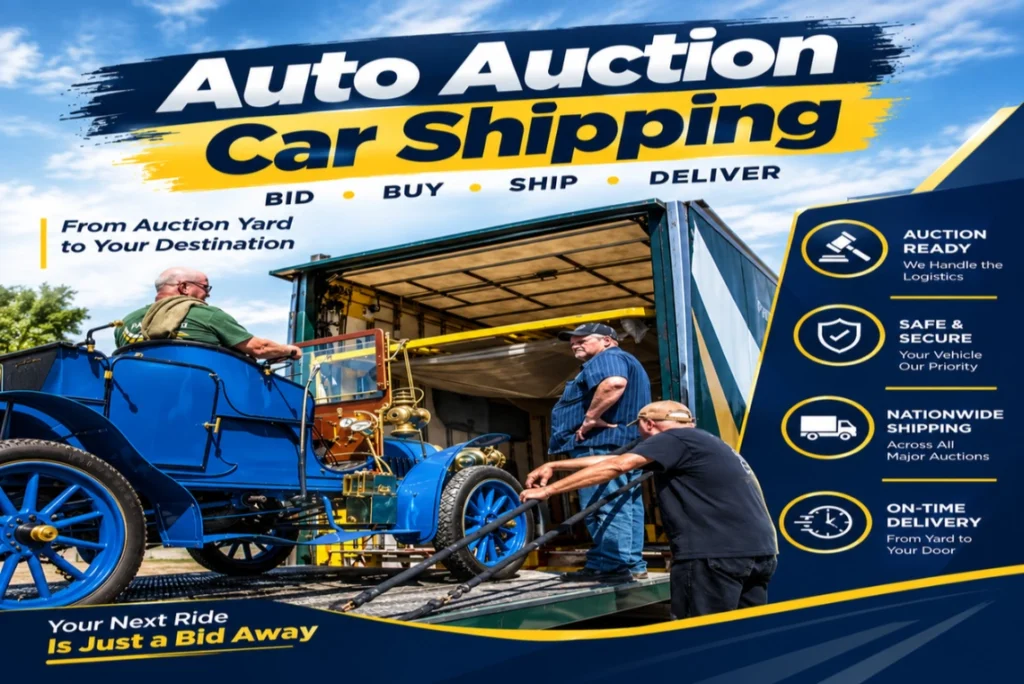
You won an automobile at the auction, then. What now?
Every week, thousands of purchasers ask that question. To be honest, winning the offer is the simple part. Getting the car from the auction lot to your driveway is where things quickly become tricky, particularly if you have never handled Auto Auction Car Shipping before.
Let’s dissect it without the superfluous details.
Shipping a regular automobile is easy. You have an address, a buyer, and a seller. Completed.
Transporting vehicles for Auto Auction Transport is an entirely separate matter. Gate fees are incurred. forms for release. As soon as your win is posted, storage clocks start to tick. If you miss a deadline, you will have to pay daily storage fees that accumulate more quickly than you might anticipate.
Auction shipping is distinct in a few ways:
Nobody notifies you about this until three days into the storage fees. Not enjoyable.
It’s likely that the car you purchased was either insured or salvaged.
Copart Car Shipping operates via a member portal. You will receive gate release information and member numbers upon winning, which you must give to your transportation provider. In theory, it’s simple. In actuality? A field is overlooked, the form bounces back, and you find yourself behind schedule.
IAA Car Shipping operates mostly in a same manner. Additionally, buyer numbers and particular documentation criteria are used in insurance auto auctions. Every yard has its own peculiarities; some move quickly, while others are infamously hesitant to release. Before assuming it will be quick, ask around.
Manheim Auto Transport, on the other hand, mostly handles dealer-grade and cleaner-title automobiles. There is less drama surrounding salvage, but there is still a lot of logistics to handle, particularly at bigger places during the busiest auction season.
Purchasing salvage? Then, transporting salvage vehicles presents its own challenges.
Salvage Vehicle Transport requires flatbed trucks, not the typical open carriers used for conventional vehicles, for non-running autos. Your pricing is altered only by that. Not every truck on the road is prepared for a dead battery, a blown transmission, or a car that just won’t roll, thus it also reduces the number of carriers who can even handle the task.
Here are some quick pointers for transferring a salvage unit:
Surprise fees are disliked by all. You can avoid the headache later by being aware of this information beforehand.
This is an honest overview of the entire procedure.
First, win the bid. This is where the clock begins, of course.
Obtain your documentation. This comprises the invoice, release authorisation, and buyer number. Each auction house takes a slightly different approach to this.
Make a carrier reservation. Car Shipping from Auto Auction can be arranged through auction car transportation firms. Prices might vary greatly depending on the distance, the type of vehicle, and the busiest time of year, so you should get quotations from multiple sources rather than just one.
Give the carrier the release information. To actually pull the car, they’ll need your buyer ID, gate pass, and lot number.
Track the pickup. The majority of trustworthy Auto Auction Vehicle Transport companies provide you a window for pickup rather than a precise time. Auction yards are bustling locations. Here, patience is helpful.
Delivery and inspection constitute step six. Before signing off, compare the vehicle with the bill of lading. This is more important than most people realise, particularly for salvaging units that already have damage.
That’s all. It’s not flashy, but if you follow the instructions, it works.
Although prices may appear arbitrary at times, they are not. The cost is driven by a few actual factors:
Be cautious if a quote looks excessively low in comparison to others. That’s typically an indication of unstated costs or a broker who will have trouble locating a truck for your route.
Not every transportation provider is adept at handling auction pickups. Some people only move private parties, and the documentation that auctions entail can be a hindrance.
Seek a supplier who:
A business that has shipped hundreds of auction cars will go more quickly and encounter fewer problems than one that only sometimes dabbles in it. Experience is crucial in this situation; “good enough” is insufficient because a delay could result in daily storage costs that reduce any bargain you were able to get at the auction.
Once you understand the procedures, Auction Vehicle Shipping is not difficult. Simply put, it’s foreign the first time around, and that’s precisely where mistakes occur. You might overlook a form, forget a deadline, or make an assumption that results in an additional storage fee or two.
Organise your documentation as soon as possible. As soon as you win, reserve your carrier. Additionally, before transferring your business to transport providers, don’t be scared to ask them pointed questions regarding their auction experience.
The majority of auctions give you two to three business days before storage costs start to apply. To avoid additional fees, reserve your carrier as soon as you win.
Not precisely. Not every business is registered or familiar with the procedure at every yard, and the carrier requires your buyer number and release authorisation.
Yes, usually a little. Flatbed trucks, which are more expensive than regular open carriers, are needed for non-running autos.
The auction invoice, lot number, gate release documents, VIN, and your buyer number. Copart, IAA, and Manheim have slightly different requirements.
Open transportation is acceptable and less expensive for the majority of ordinary cars. For more expensive or vintage cars that require further protection, enclosures make more sense.
Until the car is picked up, you will be charged daily storage fees. It pays to move promptly because these can mount up quickly.
An Auto Auction Delivery Service coordinates the pickup and delivery of vehicles from auction yards, including documentation, carrier scheduling, and transportation arrangements.