We partner with professional vehicle transport companies that specialize in shipping all types of vehicles across all 50 states!
Ever wonder what actually happens after you book a car shipment? Like, what’s going on behind the scenes between “I paid for this” and “my car showed up”?
Most people don’t. They just want the car to arrive, in one piece, on time. Fair enough. But understanding the process — even just the basics — makes you a smarter customer. You’ll ask better questions. You’ll spot red flags faster. And you’ll worry a lot less during the whole thing.
So let’s pull back the curtain on auto logistics and walk through exactly how vehicle shipping works, start to finish.
At its core, auto logistics is the entire system of moving vehicles from one location to another — efficiently, safely, and (ideally) on schedule. It’s not just trucks driving down highways. It’s routing, scheduling, insurance, inspections, and coordination between multiple parties.
This entire ecosystem falls under what’s often called Automotive Logistics or, more broadly, Automotive Supply Chain Logistics — the network of processes that gets a vehicle from a factory, dealer lot, or private owner to its final destination.
Think of it like a supply chain, except the product is a car instead of a box of sneakers. Same principles apply: planning matters, timing matters, and a lot can go wrong if any single link in the chain drops the ball.
Before diving into the process itself, it helps to know who’s actually involved. There are usually three main players.
That’s you. You own the vehicle, and you’re paying for it to get from Point A to Point B.
Many companies offering Auto Logistics Services online are actually brokers. A broker doesn’t own trucks. Instead, they connect your shipment with an available carrier from their network, handling paperwork, pricing, and communication along the way.
The carrier is the company that physically owns and operates the truck. They’re the ones actually loading your car and driving it across the country. A full-service Auto Logistics Company sometimes acts as both broker and carrier, managing the entire process in-house.
Sometimes a company is both broker and carrier. Sometimes they’re separate entities entirely. Knowing the difference matters, especially if something goes wrong and you need to figure out who’s responsible.
Here’s the real breakdown, from booking to delivery.
You provide basic details — vehicle make, model, pickup location, delivery location, and preferred dates. Based on that, the company generates a price estimate.
Quotes can vary a lot between companies. That’s normal. Different carriers have different routes, capacity, and pricing models.
Once you pick a provider, you’ll sign an agreement outlining:
Read this carefully. Seriously. This document protects you if something doesn’t go as planned.
If you’re working with a broker, this is where they match your shipment to an available carrier truck. This step can take anywhere from a few hours to a few days, depending on route demand and truck availability.
Before your car gets loaded, the driver performs a condition inspection. documenting any existing scratches, dents, or damage. You’ll usually sign off on this report too. It’s your protection in case of transit damage later.
Then your car gets loaded onto the truck, secured with straps or wheel locks, and the journey begins.
This is the part you don’t really see. Your car travels along with several others on the same truck, following a route that may include multiple pickups and drop-offs.
Weather, traffic, and mechanical issues can all affect timing here. Most companies provide a delivery window rather than a guaranteed exact date, and that’s actually a good sign overly specific promises are often a red flag.
Once your car arrives, you (or someone you designate) inspects it again, comparing its condition against that original pickup report. If everything checks out, you sign off and take possession.
If there’s new damage, this is the moment to document it and start a claim, not weeks later after the memory (and the evidence) has faded.
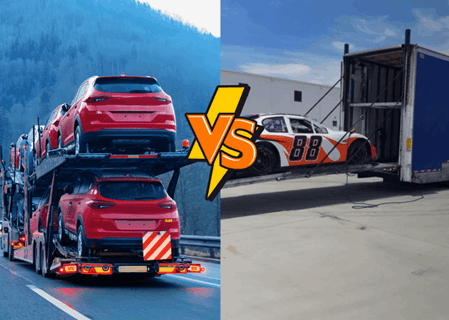
Not every truck looks the same, and the type you choose affects both price and protection level.
Open transport is the standard option. Cars ride on an uncovered trailer, exposed to weather and road debris. It’s affordable, widely available, and perfectly safe for the vast majority of vehicles.
Enclosed transport puts your car inside a fully covered trailer. More expensive, definitely. But it’s the go-to choice for classic cars, exotic vehicles, or anything where extra protection genuinely matters.
Most people don’t need enclosed transport. But if your car has serious value — financial or sentimental — it’s worth the upgrade.
Another choice you’ll make early in the process.
Big rigs can’t always navigate narrow residential streets, so even “door-to-door” sometimes means meeting at a nearby parking lot instead of your literal driveway. Worth asking about upfront.
Shipping a single car is one thing. Moving dozens or hundreds of vehicles is a completely different operation.
Fleet Logistics Services cater to businesses that need to relocate multiple vehicles at once — rental companies, corporate fleets, or delivery services expanding into new regions. These operations require tighter scheduling, bulk pricing, and often dedicated account managers to keep everything on track.
Similarly, Dealer Vehicle Logistics covers the movement of inventory between manufacturers, auctions, and dealership lots. Dealers rely on consistent, predictable Vehicle Distribution Services to keep their lots stocked without gaps in inventory, especially around high-demand seasons or new model releases.
Both of these fall under the larger umbrella of Vehicle Logistics Services and Vehicle Transport Logistics, just operating at a bigger scale with more moving parts than a single personal vehicle shipment.
A few core factors drive pricing across the industry.
Booking further in advance almost always helps. Last-minute requests limit carrier availability and often mean paying a premium just to secure a spot.
Every legitimate carrier provides cargo insurance covering your vehicle during transit. But coverage amounts and terms vary quite a bit from company to company.
Before booking, always confirm:
Don’t assume coverage automatically applies to everything. Get the specifics in writing.
A quick list worth reviewing before you book anything.
Small oversights here can turn into big headaches later. A little diligence upfront saves a lot of frustration down the road.
A few things worth checking before you commit.
Legitimate carriers and brokers should be registered with the FMCSA (Federal Motor Carrier Safety Administration) and hold a valid USDOT number. This is public information you can verify directly on the FMCSA website.
Don’t just trust the testimonials on a company’s homepage. Check third-party review sites, and pay close attention to how the company responds to negative feedback.
A trustworthy provider of Car Transport Logistics will answer clearly and promptly. If you’re getting vague answers about insurance, pricing, or timelines, take that as a warning sign.
Contracts, inspection reports, and communication should all be in writing. Verbal promises don’t hold up if a dispute happens later.
Vehicle shipping isn’t complicated once you understand the basic flow: quote, booking, dispatch, pickup, transit, delivery. Each step has its own small details worth paying attention to, but none of it is mysterious once you know what to expect.
Whether you’re shipping one car or coordinating Vehicle Transport Logistics for an entire fleet, the fundamentals stay the same — research, documentation, and asking the right questions before you commit.
Do your research, ask the right questions, and document everything along the way. That’s really the whole formula for a smooth, stress-free shipping experience.
It depends on distance and route demand, but most shipments take anywhere from a few days to about a week for cross-country or long-distance routes.
Yes. Open transport is the industry standard and used for the vast majority of vehicles shipped nationwide. It’s reliable, affordable, and widely available.
Not necessarily, but someone should be available to inspect the vehicle and sign off on its condition at both pickup and delivery.
Reputable carriers carry cargo insurance for exactly this situation. Document the vehicle’s condition thoroughly before pickup, and file a claim promptly with photos if damage occurs.
Ideally a few weeks ahead, especially during high-demand seasons. This gives carriers more flexibility and usually results in better pricing.
Yes, but it requires special loading equipment, since the vehicle can’t drive onto the truck under its own power. This typically adds to the overall cost.
Yes. Businesses moving multiple vehicles typically rely on Fleet Logistics Services or Dealer Vehicle Logistics, which involve bulk scheduling, dedicated account support, and pricing structures built for volume rather than single shipments.